



Reading start-up NewOrbit raises £13.8m to fly satellites where Elon Musk won’t
June 9 2026
A Reading start-up is betting that the future of the space economy lies not further out, but lower down, and it has just raised £13.8 million to prove the point.
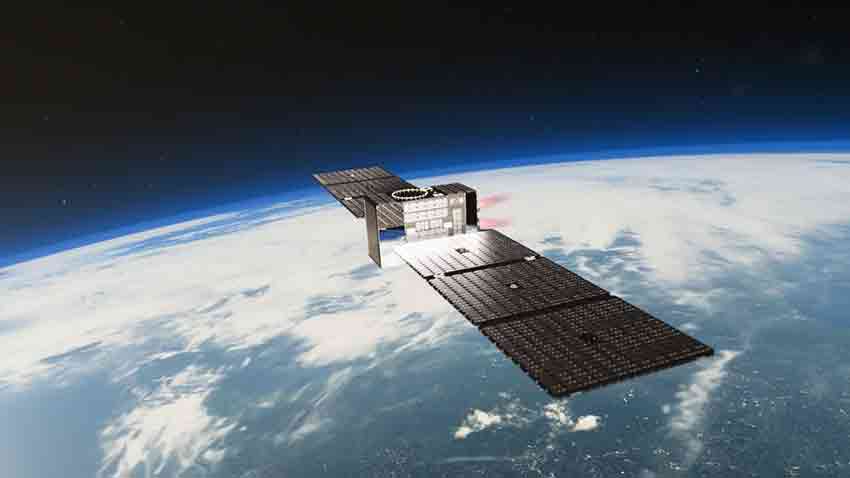
NewOrbit, founded in 2021 and based in Berkshire, is building what it says will be the world’s first commercial satellite designed to operate in very low Earth orbit (VLEO), the sliver of space between 200 and 300 kilometres above the ground. The fresh capital takes the total raised by the company to £21.6 million and, if its bet pays off, could eventually make it a homegrown rival to Elon Musk’s Starlink.
“If you look at the sky right now, there are planes flying at 10km, and then there is emptiness until you hit the International Space Station at 500 to 600km,” said Anatolii Papulov, the company’s 30-year-old co-founder and chief executive. “We are bridging that gap. We can fly satellites three times closer to the ground, unlocking this entirely new type of orbit.”
The round was led by Voyager Ventures, an investor in climate and deep-technology start-ups. Other backers include David Kirk, the former chief scientist at chipmaker Nvidia, and Lawrence Leuschner, co-founder of the e-scooter operator Tier Mobility, now rebranded as Dott. The arrival of that calibre of investor reflects a wider appetite for British deep tech, a trend underlined when Sir Richard Branson’s venture firm raised £250 million to back technology start-ups.
The money will fund NewOrbit’s move into a 2,000 sq m manufacturing facility in the Thames Valley in early 2027, ahead of a maiden satellite launch pencilled in for 2028. The company plans to fly commercial customers on that first satellite to demonstrate the benefits of the orbit before scaling up production.
The timing is striking. NewOrbit’s raise lands just as SpaceX prepares what is set to be the largest stock market debut in history, with the rockets group targeting a $1.75 trillion valuation and a raise of about $75 billion on its Nasdaq listing this week.
“It is very exciting,” Papulov said. “SpaceX is an AI infrastructure company, and most of its valuation is coming from the future data centres that they’re putting into space. Space is exciting because it can bring the infrastructure that our terrestrial networks cannot handle.”
His pitch rests on physics. Services such as Starlink, which orbit far above the VLEO band, rely on large antennas mounted on rooftops. “When you move closer to Earth, your signal becomes stronger,” Papulov said. That proximity, he argues, allows NewOrbit to supply the hardware for sharper satellite imagery, stronger telecommunications and more accurate weather data — the same race for orbital bandwidth that drew ALL.SPACE its own $44 million to advance satellite communications technology.
For now, the company sells satellites rather than the services they enable. “We do not do imagery or telecommunication at the moment, but we can supply this technology to anyone else who wants to build these capabilities,” Papulov said. “It’s difficult to compete with Starlink, but still, everyone is looking at sovereign capabilities today. Everyone wants to have their own telecommunication capabilities. Everyone wants to have their own network.”
Operating in VLEO is notoriously punishing. Atmospheric drag and oxidation burn up standard satellites within weeks, dragging them out of orbit and corroding their surfaces. NewOrbit says it has cracked the problem with an electric propulsion system designed to keep its satellites flying for five years.
“Our propulsion throws particles from the satellite at 50km per second. It is an unimaginable speed,” Papulov said, adding that the system is so fuel-efficient that even satellites with small tanks can hold their position. The propulsion challenge is one British engineers are increasingly tackling head-on; fellow UK venture Magdrive is testing a metal-fuelled spacecraft engine in a parallel push to power the next generation of satellites.
Papulov first conceived of NewOrbit while studying physics, developing the idea during a master’s degree that included a research stint at MIT. He recruited his co-founder, Ruslan Rakhimov, 32, an engineer he had worked with before, to help design and manufacture the satellite’s components.
The company now employs 30 people in Berkshire, many recruited from rocket labs around the world, including SpaceX. One senior engineer who spent nearly two decades at Nasa’s Jet Propulsion Laboratory relocated from Los Angeles to Reading to join. “We are bringing the world’s best talent to build and unlock this orbit,” Papulov said.
The ambition chimes with a government keen to position Britain as a serious space player, having pledged billions to scale up the domestic space sector. Craig Brown, deputy director for space ecosystem at the UK Space Agency, called the investment “a strong signal that British space technology is attracting serious global investment”.
“The fact that VLEO is being opened up for commercial operations from the UK, with world-class engineering talent relocating here to make it happen, demonstrates the strength and ambition of our national space ecosystem,” he added.