



The Quiet End of the Entrepreneur’s Tax Break
April 30 2026
Business Asset Disposal Relief, once known as Entrepreneurs’ Relief, has been cut back so far that, from April 2026, it offers almost no real advantage.
New analysis from The Investors Centre tracks what the change means for UK business owners.
For two decades, founders selling a business in the UK knew where they stood. The first £1 million of qualifying gains was taxed at 10 percent. That was half the headline rate, and a third of what higher earners paid on listed shares.
The relief was first called Entrepreneurs’ Relief. It was renamed Business Asset Disposal Relief, or BADR, in 2020. Either way, it was the tax system’s nod to the people who built UK businesses. That nod is now, in effect, gone.
From 6 April 2026, the BADR rate stands at 18 percent. That is the same rate every other higher-rate taxpayer pays on share gains. The relief still exists on paper. In practice, the saving has been closed off.
What is Business Asset Disposal Relief, and what’s changed?
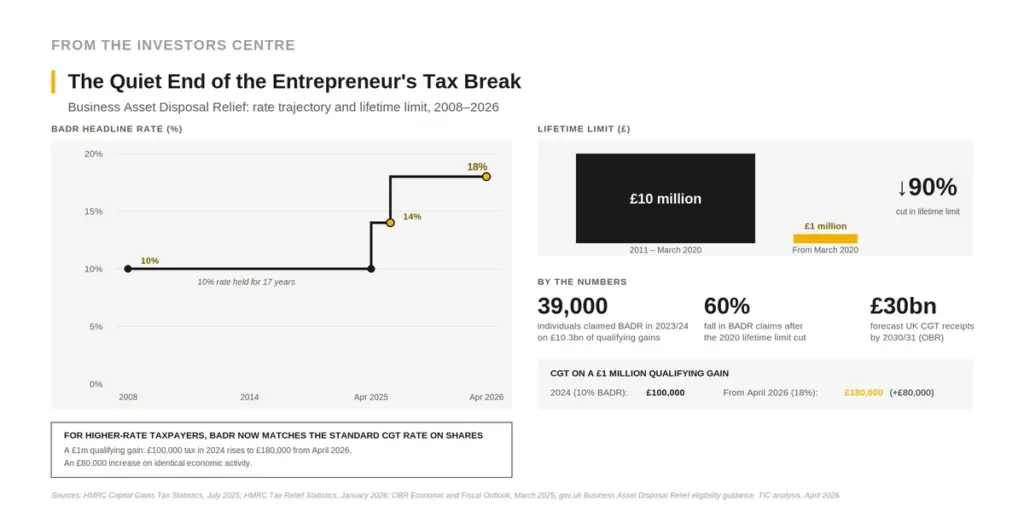
BADR is a Capital Gains Tax relief for people selling all or part of a business they have run. Until April 2025 it taxed the first £1 million of qualifying gains at 10 percent. From 6 April 2026, that rate is 18 percent, the same as the standard higher rate of CGT on shares.
The change wasn’t sudden. It was paced out over six years, and most of it happened away from the front pages.
The first move came in March 2020, when the lifetime limit was cut from £10 million to £1 million. HMRC data shows the result: claims and tax collected both fell by 60 percent in a single year.
The second move came in October 2024. The BADR rate was held at 10 percent, but the main CGT rate on shares rose from 20 percent to 24 percent. For a brief moment, BADR looked more valuable than ever. The third move closed it down.
That third move runs in two stages. The BADR rate rose to 14 percent from April 2025. From April 2026, it has now risen again to 18 percent. A higher-rate taxpayer selling a business now pays the same rate as someone selling shares in a tracker fund.
What the numbers say
HMRC’s most recent figures, published in July 2025, show 39,000 people claimed BADR in 2023/24. Total qualifying gains came to £10.3 billion, generating £1.0 billion in tax. That’s about 8 percent of all CGT receipts.
The activity is heavily concentrated. Just 21 percent of claimants, those with gains of £500,000 or more, paid two-thirds of all the BADR tax. The relief has mostly served founders selling sizeable stakes, not retiring sole traders.
For that group, the change is sharp. A founder taking a £1 million qualifying gain in 2024 paid £100,000 in CGT under the old 10 percent rate. The same gain in 2026/27 attracts £180,000. That’s an extra £80,000 on the same sale, with no allowance to offset it.
The wider picture makes it harder still. The Annual Exempt Amount has fallen from £12,300 in 2022/23 to just £3,000 from April 2024. That’s the lowest figure in real terms since the mid-1990s. HMRC estimates that 173,000 more people have been drawn into paying CGT as a result.
Are business owners selling early to beat the deadline?
Yes, and the response is already showing up in the data. The Office for Budget Responsibility’s March 2025 forecast puts CGT receipts at £20.3 billion in 2025/26, a 53 percent jump in a single year, driven mainly by founders speeding up sales to lock in the lower rate.
The OBR expects receipts to keep climbing. Its forecast puts CGT at £25.5 billion in 2029/30, and £30 billion by 2030/31, more than double the 2023/24 figure. CGT is on track to become one of the fastest-growing lines in the public finances.
The takeaway for business owners is plain. The tax rules around selling a company are meaningfully tougher than they were a year ago, and the disposals data already reflects that.
Where does the cash go after a business sale?
Increasingly, into ISAs and pensions, the only wrappers the post-2024 tax regime still rewards. Stocks and Shares ISAs alone now shelter around £5.6 billion in CGT and dividend tax every year.
That figure, from AJ Bell analysis of HMRC data published in March 2025, has roughly doubled in six years. The ISA wrapper is now the most valuable tax shelter in the UK system, partly because the rules around it have been tightened in every other direction.
The Investors Centre modelled the cost of holding a portfolio outside an ISA over 10 years. We used April 2026 CGT rates and the long-run return data from the Investment Association. The results are consistent across investor profiles:
|
Profile |
Annual contribution |
10-year ISA value |
10-year GIA value after CGT |
Cost of not using ISA |
|
Cautious |
£5,000 |
£78,227 |
£71,340 |
£6,887 |
|
Moderate |
£10,000 |
£156,455 |
£142,680 |
£13,775 |
|
ISA maximiser |
£20,000 |
£312,910 |
£285,360 |
£27,550 |
Source: TIC modelling, April 2026. 8 percent annual return, gains taken each year, higher-rate taxpayer. Illustrative only.
For a founder taking £1 million off the table, the £20,000 ISA limit looks small against the proceeds. But every pound that goes through it grows tax-free for as long as it stays there. Add pension contributions, which carry their own tax breaks, and you have the most efficient combination the UK system offers.
A narrowing window
The political direction is settled. In two budgets, CGT has shifted from a niche tax on a small group of disposals to a major revenue line forecast at £30 billion within five years. The 18 percent BADR rate is unlikely to be reversed.
For business owners thinking about a sale, three things matter. First, gains taken before 6 April 2026 still attract the 14 percent rate, so anyone in the middle of a deal should know which side of that date they fall on. Second, the wrapper that receives the proceeds matters more than it used to. Third, the case for funding ISAs and pensions early, for the founder and for adult children with their own allowances, is materially stronger than it was three years ago.
The word that disappeared from the legislation in 2020 was “Entrepreneurs’.” The relief that carried the name is now, in 2026, much the same as everything around it. The advantage wasn’t removed in a single budget. It was closed quietly, line by line, over six years.
Who are The Investors Centre?
The Investors Centre is the UK’s leading broker comparison and review platform. Founded in 2023 and based in Suffolk, the company publishes independent broker reviews, tested with real money, across UK, Australian, Canadian, and Irish markets. Every reviewed broker is opened, funded, and used by the editorial team before publication.
International coverage is published at theinvestorscentre.com, and the trading and investing data hub is updated quarterly.